
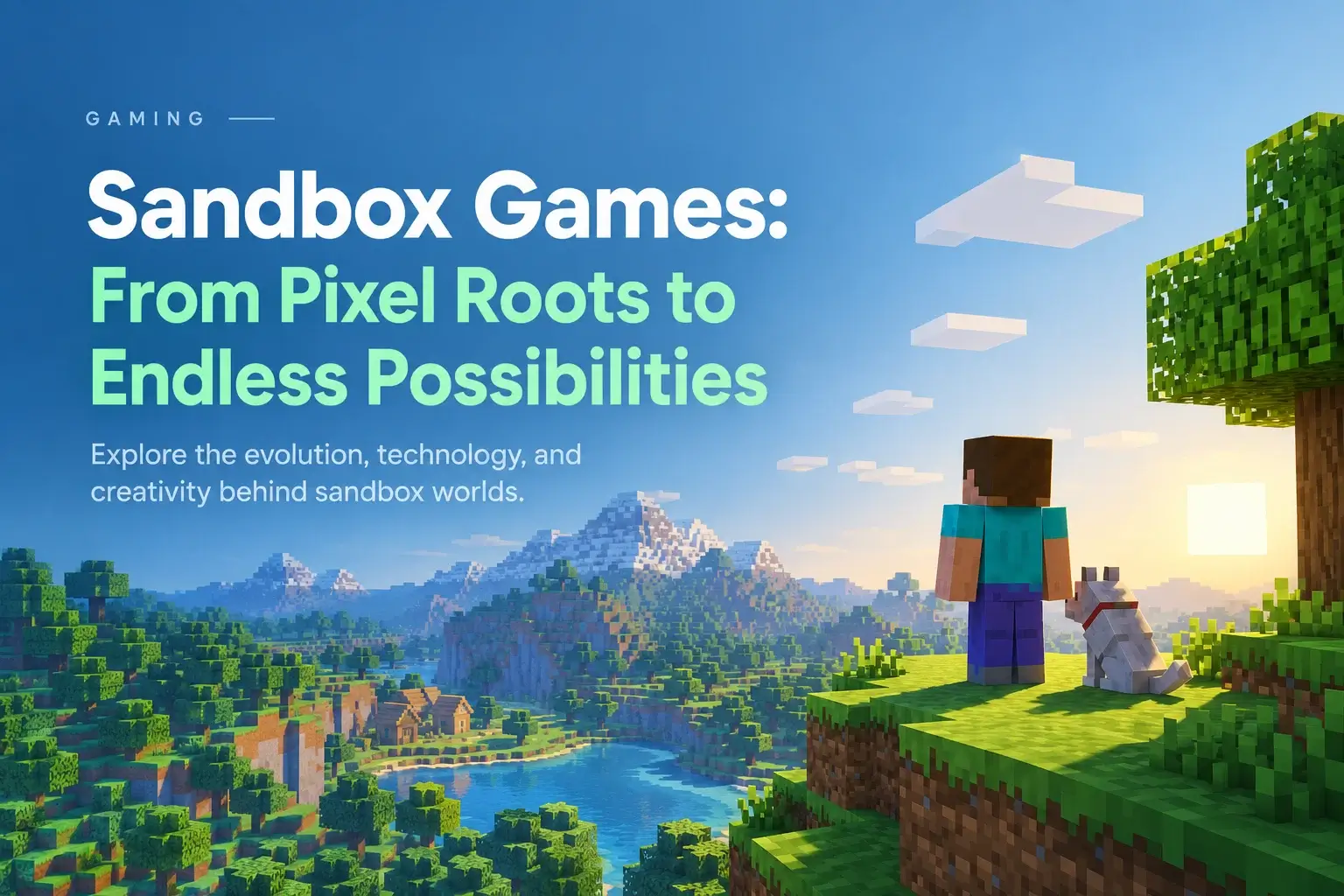
Introduction: The Endless Appeal of Sandbox Worlds
Understanding the evolution of sandbox games reveals how history shapes modern virtual choices daily. Every enthusiast evaluates sandbox mechanics, freedom, and graphical styles constantly. When analyzing sandbox game design, player creativity matters most. Gamers always compare retro pixel graphics with modern realistic physics before playing. Furthermore, modern sandbox design decisions shape your daily entertainment style. Simple block builders deliver maximum creative freedom for casual architects. Meanwhile, complex physics engines offer unmatched immersion while exploring anywhere. Hence, knowing the genre’s roots saves you from missing out on hidden gems. Assess your personal gaming preferences carefully right now.
The Retro Pixel Foundation
Looking at the evolution of sandbox games, one can see that at first, such games were based on retro-style pixel graphics. Also, it is important to highlight the fact that the players loved the fact that they could create anything they wanted without any limitations. Thus, taking into account the feedback from players, developers managed to enhance the core of the games quite fast. Moreover, the technology has progressed immensely in the recent decades. Therefore, modern games have beautiful lightning and realistic physics.
Minecraft and the Sandbox Gold Standard
When tracking the evolution of sandbox games, classic Minecraft set the ultimate gold standard. For instance, players mine blocks to construct giant castles. Moreover, simple pixel aesthetics captured millions of global fans. Additionally, survival elements added thrilling tension to exploration. Consequently, community servers fostered massive collaborative engineering projects. Thus, learning fundamentals became an internet cultural phenomenon. Furthermore, developers updated world generation rules frequently. Hence, players never grew tired of exploring. In short, pixel art laid a brilliant foundation, and sandbox design changed forever back then.
The Shift Toward Modern Visual Realism
When considering the evolution of sandbox games, the current trend is that the game aims for visual realism. For example, there is a use of up-to-date technology such as ray tracing and physics engines in the game. Additionally, the demands for hardware have increased significantly in the whole gaming industry; thus, players need powerful computers to play the new assets. Also, the weather conditions greatly influence open world games. As a result, the building processes are more realistic compared to those in previous versions. Moreover, there are continuous graphical experiments in each game release. On the contrary, old pixel games retain their fan base.
Procedural Generation and Infinite Horizons
In terms of the evolution of sandbox games, procedural methods have developed much more than basic algorithms. For example, contemporary games create entire solar systems procedurally. In addition, the use of advanced math algorithms produces terrain features automatically. This means that players can enjoy exploring new worlds without having to deal with loading screens. Furthermore, procedural code becomes optimized by game developers all the time. In this way, current hardware can perform smoothly even in extremely large virtual worlds. This means that each gaming session offers unique experience of exploration. In summary, mathematics works brilliantly in creating infinity of virtual worlds.
Physics Engines and Structural Integrity
Moreover, physics engines transformed basic block interaction permanently. For instance, destruction physics let players demolish structures realistically. Furthermore, fluid dynamics simulate flowing water and lava accurately. Therefore, building contraptions requires genuine engineering knowledge. Additionally, gravity affects every placed object within worlds. Thus, structural integrity matters during massive architectural projects. Meanwhile, older games relied on static block grids. Hence, physics updates added incredible gameplay depth. Ultimately, realistic physics elevate sandbox immersion entirely. Therefore, players experiment with complex mechanical builds.
Cross-Platform Multiplayer Integration
Additionally, cross-platform multiplayer redefined social sandbox experiences. For instance, friends play together across different gaming consoles. Furthermore, mobile devices connect with powerful desktop computers. Therefore, barriers between gaming communities vanished completely. Additionally, cloud servers maintain persistent shared persistent worlds. Thus, players collaborate on massive projects anytime. Meanwhile, developers manage server infrastructure seamlessly behind scenes. Hence, multiplayer integration feels effortless for users. Ultimately, shared universes amplify creative potential exponentially. Therefore, multiplayer drives modern sandbox popularity.
Virtual Reality and Spatial Immersion
Furthermore, virtual reality integration revolutionized personal sandbox immersion. For instance, players sculpt virtual clay with bare hands. Furthermore, spatial audio makes digital environments feel alive. Therefore, building towers feels physically engaging and real. Additionally, VR headsets track precise hand movements naturally. Thus, user interfaces adapt to virtual reality controllers. Meanwhile, traditional flat screens remain widely popular choices. However, VR offers unmatched spatial perspective depth. Ultimately, immersive technology expands creative design possibilities. Therefore, virtual reality attracts hardcore sandbox fans.
User-Generated Content and Community Mods
Moreover, user-generated content and modding changed everything. For instance, players build entire game modes inside sandboxes. Furthermore, custom scripts introduce complex RPG mechanics easily. Therefore, community creators drive long-term game success. Additionally, developers support modding with official software tools. Thus, sharing custom creations takes minimal effort. Meanwhile, players download community maps with single clicks. Hence, replayability expands infinitely through user mods. Ultimately, community passion sustains aging game titles. Therefore, modders represent the heartbeat of sandboxes.
Narrative Integration in Open Worlds
On the other hand, the evolution of the concept of narrative integration led to sandbox game experiences. For example, building games based on story present objectives for the players. Moreover, the use of lore adds reason to gather resources. This way, players get to experience progression with creative freedom. In addition, character development makes survival emotional. Consequently, the combination of narrative and sandbox results in unique gameplay. On the other hand, those who favor sandbox want to be completely free. Therefore, different game modes are available.
Artificial Intelligence and Ecosystem Simulations
Moreover, artificial intelligence improves non-player character behavior. This is because villagers perform automated functions in their settlements. Moreover, wildlife responds to the construction of buildings by players. Consequently, virtual worlds become inhabited instead of being vacant. In addition, pathfinding enables smooth operation of automated systems without any glitches. As a result, there is no frustration during the operation of extensive bases. On the other hand, previous games had basic and static scripts for non-player characters. Consequently, intelligent AI makes sandbox ecosystem simulation realistic.
Educational Applications in Classrooms
In addition to this, there was a widespread adoption of the sandbox games in the field of education. It is possible to give such an example that block worlds are used by teachers to teach children programming. Moreover, students recreate history on the server level. Consequently, learning geometry turns into an interactive team activity. Also, collaborative building helps to develop teamwork skills. Virtual reality thus serves as a powerful learning environment. At the same time, special educational versions ensure safe networks. In this regard, schools welcome gaming as a means of education.
Digital Architecture and Design Principles
Additionally, architectural design software influences sandbox building. For instance, professional architects construct real buildings inside games. Furthermore, precise scaling tools help design complex structures. Therefore, virtual prototypes test structural feasibility before construction. Additionally, color theory guides intricate pixel art creation. Thus, aesthetic standards rise across community servers. Meanwhile, casual players build simple dirt shelters. Hence, skill ceilings scale infinitely for builders. Ultimately, digital architecture mirrors real-world design principles. Therefore, sandbox builders demonstrate remarkable artistic talent.
Mobile Portability and App Store Dominance
Moreover, mobile devices provided an accessible way for gamers to experience sandbox games. For example, smartphones play optimized games of building blocks without any problem. Moreover, the use of touch screens makes it possible to be creative while moving around. Consequently, millions of kids become gamers using mobile devices. Moreover, the cross-save functionality allows gamers to continue playing from different devices. Thus, while commuting, gamers continue creating buildings. At the same time, the limited possibilities of mobile hardware prevent big renders. However, developers work cleverly with the rendering distance.
Reflecting on Genre Milestones
In summary, sandbox games evolved past simple experiments. For instance, retro pixels birthed a massive global industry. Furthermore, technological leaps transformed block games into art. Therefore, players enjoy breathtaking realism and infinite worlds. Additionally, community creativity continues pushing boundaries further. Thus, the genre refuses to stagnate or fade. Meanwhile, classic design principles remain universally beloved. However, innovation ensures exciting future industry growth. Ultimately, sandbox evolution reflects human imagination itself. Therefore, the genre’s legacy remains completely secure.
The Limitless Future Ahead
The future of sandbox games is boundless. For example, cloud computing will create worlds that are infinite and have all the details. In addition, neural networks will create quests on-the-go according to individual player preferences. Moreover, physics simulations will mimic real-life chemistry. In such a way, the future of sandboxes will erase the line between reality and the virtual world. On the other hand, the main pleasure of creation remains the same. Nevertheless, new technology will push the limits of creativity even higher.
Conclusions: The Legacy and Horizon of Sandbox Gaming
The progression from basic pixel art to complex photorealism highlights remarkable technological achievements. Sandbox gaming successfully bridges simple human imagination with hyper-realistic digital engineering.
- Historical Evolution: Early retro pixel experiments proved that absolute freedom captures global audiences.
- Creative Empowerment: Modern procedural generation and cross-platform capabilities expand creative possibilities infinitely.
- Future Horizons: Cloud computing architectures and adaptive neural networks will render near-infinite persistent universes.
- Click here to visit our main page
- Click here to get more information