
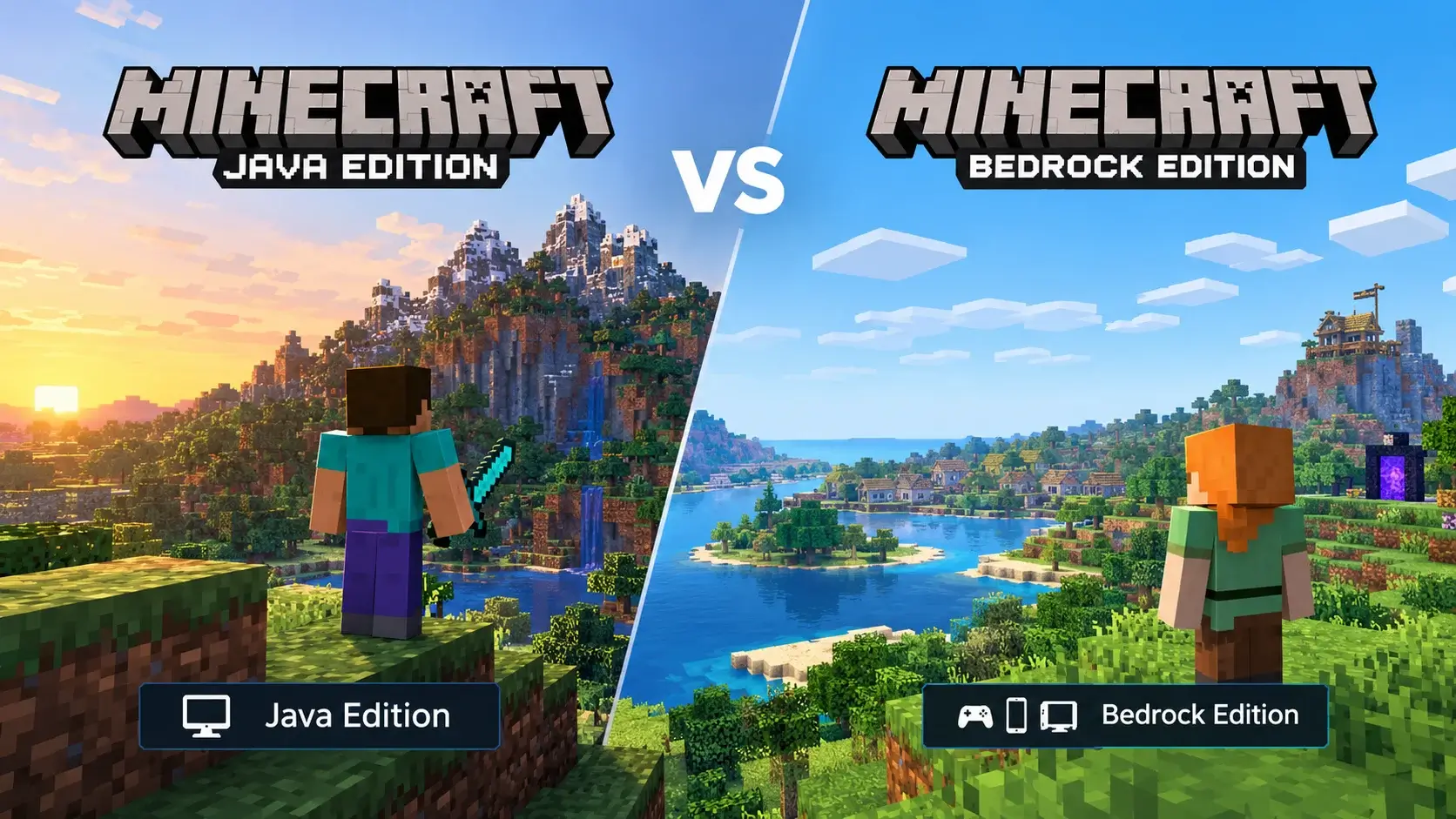
Minecraft Java vs Bedrock Edition: Which Version Should You Play?
The choice between Minecraft Java and Bedrock Edition is one of the most critical choices any gamer must make. Though both versions have similar features, the two games run on totally separate code bases, which provide certain benefits.
This will help you decide which version suits your setup depending on your purpose – be it making intricate redstone designs in PC or cross-platform play with friends using mobile devices.
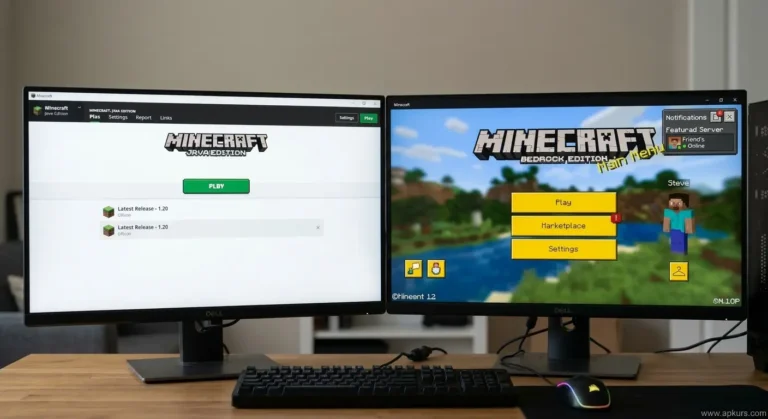
Technical Specifications & Feature Comparison
The table below breaks down the core architectural differences, multiplayer capabilities, and system requirements between both editions.
| Feature | Minecraft Java Edition | Minecraft Bedrock Edition |
| Primary Codebase | Java Programming Language | C++ Native Code |
| Supported Platforms | PC (Windows, macOS, Linux) | PC, Xbox, PlayStation, Nintendo Switch, iOS, Android |
| Cross-Platform Play | Limited (PC cross-play only) | Full Cross-Play (All Consoles, PC, & Mobile) |
| Modding Support | Advanced (Free total conversions, Forge/Fabric) | Controlled (Official Marketplace, Add-ons) |
| Redstone Mechanics | Quasi-connectivity & predictable bugs | Intuitive, bug-free component logic |
| Combat System | Weapon attack cooldown timers | Fast-paced, spam-click combat |
| Exclusive Features | Hardcore mode, off-hand slot, debug screen | Emotes, character creator, fluid block-piston push |
The Origins of Java Edition
Java Edition is the classic PC edition which was developed by Markus “Notch” Persson in 2009. This version, which is developed using only Java programming language, laid the foundation for the global gaming community.
The development and evolution of the game over several years was influenced by the PC players who contributed their feedback and suggestions. Modding using an open source codebase became its main feature.
The Rise of Bedrock Edition
The Bedrock Edition is the contemporary, multi-platform version developed by Mojang through C++ programming language. It was developed to streamline the old Pocket Edition code for the new generation of hardware.
Cross-platform gaming is the defining feature of this new edition. Friends can play together no matter whether they have an iPhone, Xbox, PlayStation, or Windows PC.
Performance and Optimization
The performance is vastly different between the two because of the following reasons based on the codes:
Java Performance: Java needs very powerful computer hardware. Sometimes, garbage collection leads to unexpected frame drops; however, high-end machines are required to run mod packs smoothly.
Bedrock Performance: Bedrock operates on almost all devices, including cheap smartphones to expensive PCs. It has been optimized in C++, making it incredibly light, stable, and power efficient.
Modding and Community Content
The freedom to modify the game varies greatly between the two versions:
Bedrock Modding: Bedrock supports add-ons for changing gameplay and visuals. Marketplace content can be paid, while free add-ons are also available from community sources.
Java Modding: Modding is very prevalent among those who play Java. Players can load total conversions, custom shaders, and performance-boosting client-side modifications for free through CurseForge and Fabric.
Multiplayer and Cross-Play
Multiplayer connectivity caters to very different audience needs:
Bedrock Cross-Play: Cross-play is Bedrock’s strongest selling point. Mobile users join console and PC players without friction, while official Realms connect groups reliably across all supported hardware.
Java Multiplayer: Java is strictly limited to desktop computers (Windows, Mac, and Linux). While connecting across different PC operating systems works smoothly, console cross-play is completely absent.
Combat Systems and Gameplay Feel
Combat sequences are different in both versions:
Bedrock Combat: The game offers fast-paced, spam-click combat system. Block and bow aim are also much quicker in this version.
Java Combat: The game uses the weapon attack cooldown timer feature in Java. Timing becomes very important in PvP and PvE combat.
World Generation and Seeds
Seed parity has improved over recent years. Terrain generation matches closely across most platforms. Still, minor structural differences occasionally pop up.
Structure coordinates can shift between versions. Exploring underground structures feels identical overall. Meanwhile, map layouts remain mostly faithful to each other.
Exclusives in Java Edition
Java holds several unique gameplay features. Hardcore mode deletes your world upon death. Additionally, spectral arrows glow through solid walls easily.
Off-hand slots hold shields, maps, and torches. This adds huge convenience during deep mining. Furthermore, debug screens give detailed technical performance stats.
Exclusives in Bedrock Edition
Bedrock introduces its own clever mechanics. Cauldrons hold lava and water much better. Similarly, dyeing leather armor works with multiple colors.
Emotes let characters express feelings during gameplay. Character creators offer deep visual customization options. Furthermore, pushing blocks with sticky pistons works smoother.
Common Bugs and Stability Issues
Bugs plague both versions of the game. However, their specific glitches feel completely different. Stability issues frustrate players on both sides.
Java bugs usually stem from mod conflicts. Bedrock bugs involve annoying movement and collision errors. Frequently, random clipping deaths frustrate survival players.
Cost and Monetization Models
Money plays a role in your choice. Java requires a one-time PC purchase. Meanwhile, third-party hosting servers cost extra cash.
Bedrock includes microtransactions inside the store. Skins, textures, and worlds cost real currency. Alternatively, free community alternatives are harder to install.
Multiplayer Server Networks
Server communities are massive on Java. Massive minigame networks host thousands of players. Custom game modes keep engagement extremely high.
Bedrock features official partner servers directly. Joining them requires zero external IP setup. Consequently, mobile users access these servers instantly.
Conclusions
Choosing between Minecraft Java and Bedrock Edition depends on how you want to play. Java Edition is a strong choice for players who enjoy extensive community mods, custom servers, and detailed redstone builds. Bedrock Edition is better suited to players who want to play with friends on compatible consoles, phones, and Windows PCs.
If you mainly play on a computer and enjoy experimenting with mods, Java is worth considering. If your friends use different devices, Bedrock is usually the more convenient option. Before choosing, check which edition your friends use and what your device supports.